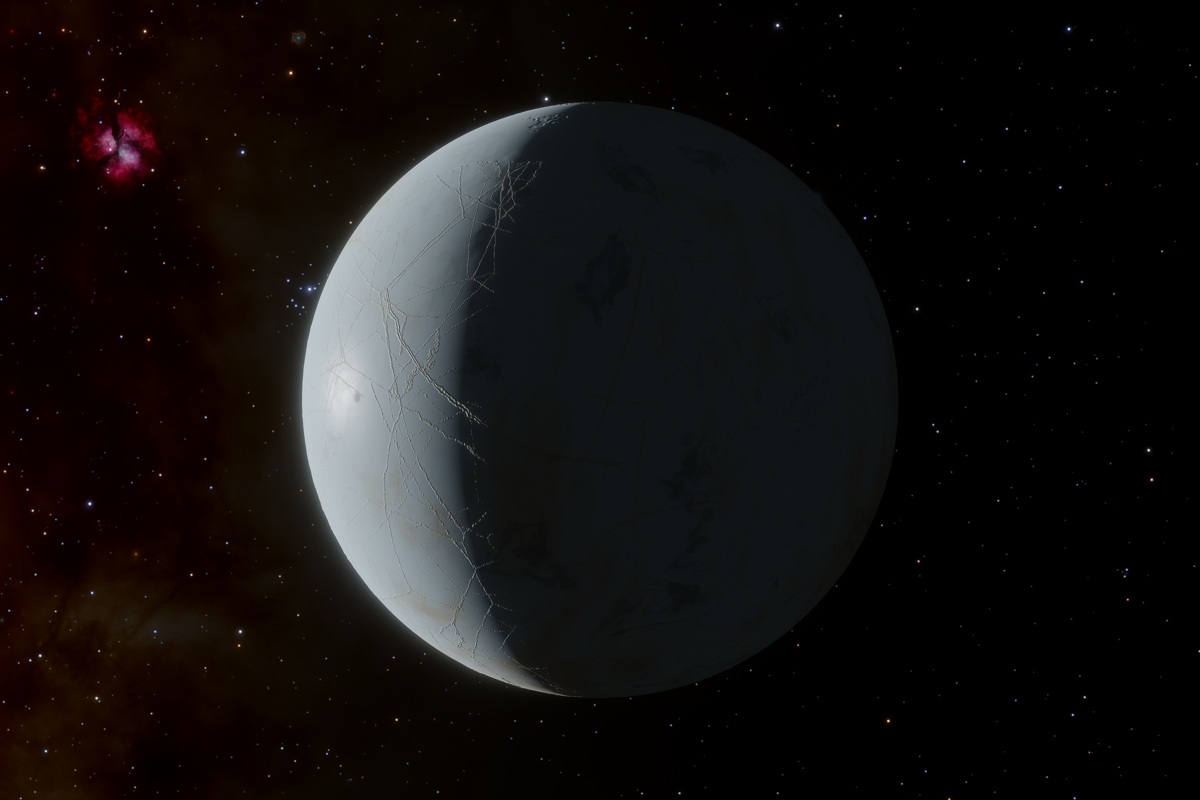
A planet with about twice Earth’s mass could be hiding far beyond Neptune, according to simulations that offer a possible explanation for the strange orbits of some of the Solar System’s most distant icy objects.
The proposed world, called Planet X2, has not been observed. Its case rests on whether its gravity can reproduce the architecture astronomers see in the outer Solar System.
The Royal Astronomical Society outlined the findings on November 23. Patryk Sofia Lykawka, based at Japan’s Kindai University and affiliated with the University of Southern Queensland, led the research with Pedro Bernardinelli and Jonti Horner.
A gravitational clue beyond Neptune
The team modelled 4.5 billion years of evolution, including Neptune’s migration and the influence of possible additional planets. A distant world of about two Earth masses reproduced several populations of objects with elongated or sharply tilted orbits, including orbital configurations resembling those of Sedna and 2012 VP113.
Preferred models place Planet X2 on an elliptical orbit with a semi-major axis of roughly 350 to 500 astronomical units. That number describes the orbit’s scale; the planet’s distance would change as it travelled around the Sun. Its closest approach would be about 200 astronomical units, compared with Neptune’s distance of roughly 30.
One astronomical unit is the average Earth-Sun distance. Even at its closest, the proposed planet would therefore remain more than six times farther from the Sun than Neptune.
A different proposal from Planet Nine
Planet X2 belongs to a distinct hypothesis from Planet Nine, which proposes a more massive body to explain features of distant objects’ orbits. The two names do not represent confirmed additions to the planetary census.
The mass estimate also says nothing definitive about Planet X2’s diameter, surface or habitability. Calling it twice Earth’s mass describes the proposed gravitational influence, rather than an observed Earth-like world.
Important limitations remain. The paper’s models did not fully match the distribution of orbital sizes inferred from Dark Energy Survey detections. Agreement with some patterns gives astronomers a hypothesis to test, rather than a detection.
How Rubin could test the idea
Rubin Observatory’s ten-year sky survey could supply more of those tests. The observatory uses repeated imaging of the southern sky to identify moving objects and determine their orbits, including faint bodies beyond Neptune.
A larger sample would let researchers check whether the predicted orbital populations persist. Finding the planet itself would provide a much stronger test. For now, Planet X2 is a proposed explanation for distant objects’ behaviour, with observations still needed to establish whether it exists.