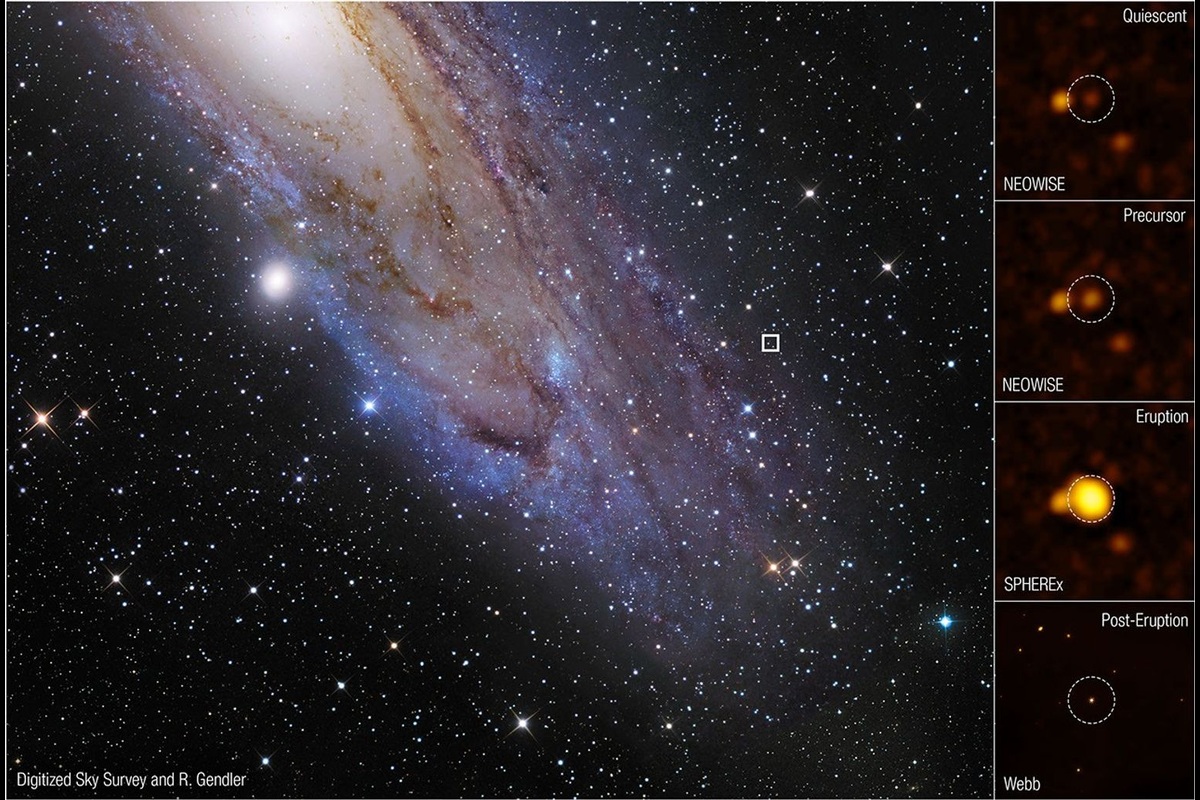
A small star spiraled through the swollen outer layers of a giant companion before a dramatic eruption in the Andromeda galaxy, according to a new study that reconstructs a rarely observed stage of stellar evolution.
The system, formally called AT 2025abao and nicknamed Bao, gave astronomers a record stretching from years of gradual brightening to an outburst and its aftermath. NASA described the findings this week, with the research published in Nature on November 18.
Seven years inside a shared envelope
The researchers estimate that the giant had about seven times the Sun’s mass and its companion roughly 70% of the Sun’s mass. Their model explains the prolonged brightening as energy released when the smaller star lost orbital energy to friction inside the giant’s gas.
This is known as common-envelope evolution: two stars occupy a shared outer layer, and their orbit rapidly tightens. It is a crucial part of theories explaining how close stellar pairs form, but the process is difficult to observe directly.
The team interprets Bao’s subsequent eruption as the companion reaching the giant’s core and merging with it. Its calculations suggest the event expelled roughly a tenth of the outer envelope, offering a way to measure how efficiently orbital energy can push stellar material into space.
Webb supplied the infrared evidence
Webb observed the system 47 days after the eruption peaked. Its infrared measurements helped the team examine surrounding dust and test models against the broader record from ground-based and space telescopes.
Kyoto University reported on November 19 that its Seimei telescope had also observed the October 2025 outburst, helping identify it as a luminous red nova and guide subsequent observations.
What remains to be seen
The reconstruction combines observations with modeling; it is not a resolved view of one star moving inside another. Continued monitoring will show how the dusty remnant settles and help test the team’s interpretation.
Future surveys could supply more examples. NASA expects the Roman Space Telescope’s wide-field observations to reveal many changing objects suitable for similar follow-up.