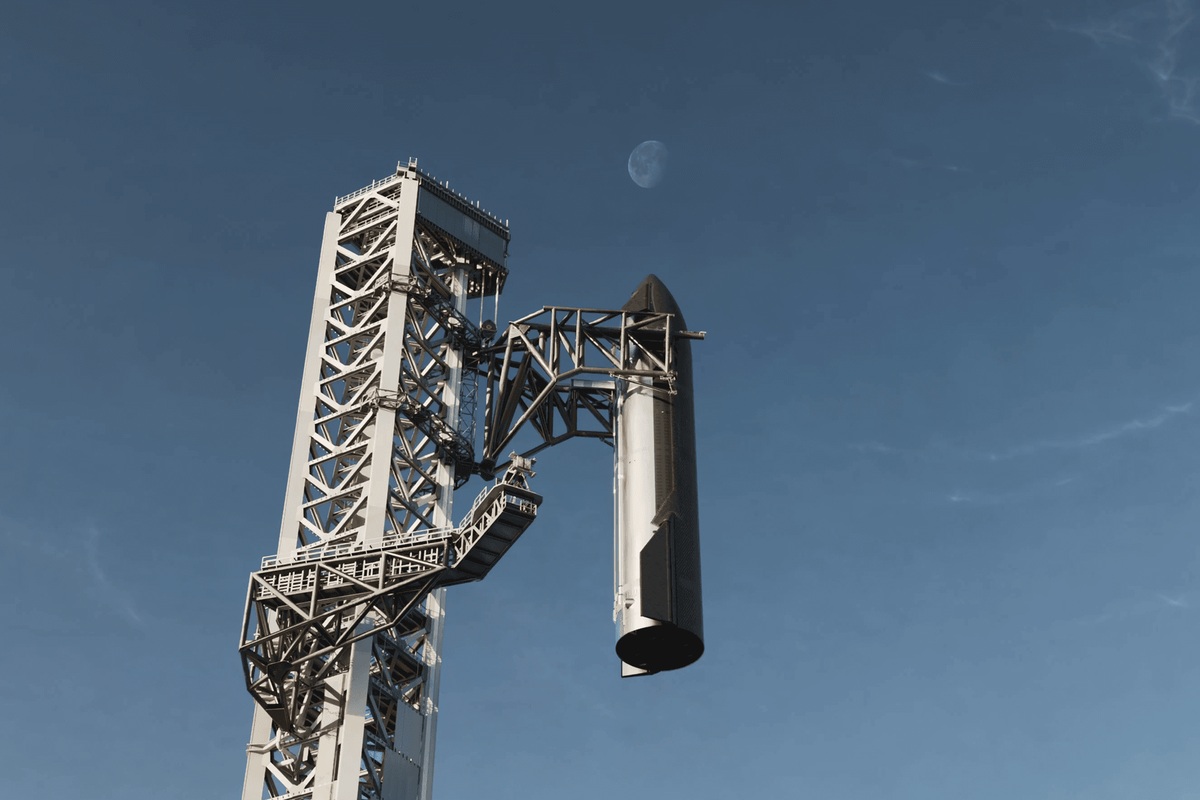
SpaceX caught a Starship spacecraft returning from orbit for the first time on Saturday, bringing the upper stage back to its Texas launch tower after a flight lasting more than 22 hours. The recovery gives Elon Musk’s company a crucial piece of the reusable rocket system it has spent years trying to build.
Ship 42 descended toward Starbase, turned upright and settled into the tower’s mechanical arms. SpaceX confirmed the result in an official video: “Mechazilla catches Starship!”
A first for the spacecraft, rather than the booster
The distinction matters. SpaceX had previously caught Super Heavy, the first stage that lifts Starship off the pad. Saturday’s achievement recovered the spacecraft that travels into orbit, deploys its payload and must survive the much faster return through Earth’s atmosphere.
Flight 15 began at Starbase on November 13. The upper stage completed 14 circuits of Earth before returning to the tower on November 14, CNBC reported. Mechanical arms nicknamed “chopsticks” supported the ship at the end of its landing burn.
The planned double catch did not happen. Super Heavy diverted from the launch site during Friday’s ascent and return sequence and exploded before reaching the Gulf of Mexico. The successful ship recovery therefore came alongside the loss of the booster.
A working mission before the landing
Starship also deployed 26 Starlink V3 satellites, adding a commercial purpose to the recovery test. SpaceX’s mission plan outlined a roughly 275-kilometer orbit and a flight of more than 22 hours, with several opportunities to divert the ship to an ocean return if necessary.
Three satellites carried cameras to inspect Starship’s heat shield from space. Those observations were intended to help controllers assess whether the ship was ready to return to the launch site. SpaceX had also changed the shield’s tile retention and gap protection following the preceding flight.
That made the final approach one part of a longer engineering test: reaching orbit, releasing satellites, checking the spacecraft and surviving reentry all had to come before the tower could catch it.
The next question is how quickly it can fly again
Recovering the upper stage moves SpaceX closer to reusing both halves of Starship. The business case, however, depends on turning recovered vehicles into repeat flights with manageable inspection, refurbishment and operating costs. Saturday’s catch establishes a recovery milestone; it does not yet establish routine, rapid reuse of an orbital Starship.
The stakes extend beyond Starlink. NASA is developing a Starship-based lunar lander with SpaceX to carry Artemis astronauts between lunar orbit and the Moon’s surface. That program still requires its own testing and an uncrewed landing demonstration before astronauts use the system.
For now, Flight 15 has answered an essential question: an orbital Starship can come home to its tower. The harder commercial test is making that return repeatable.