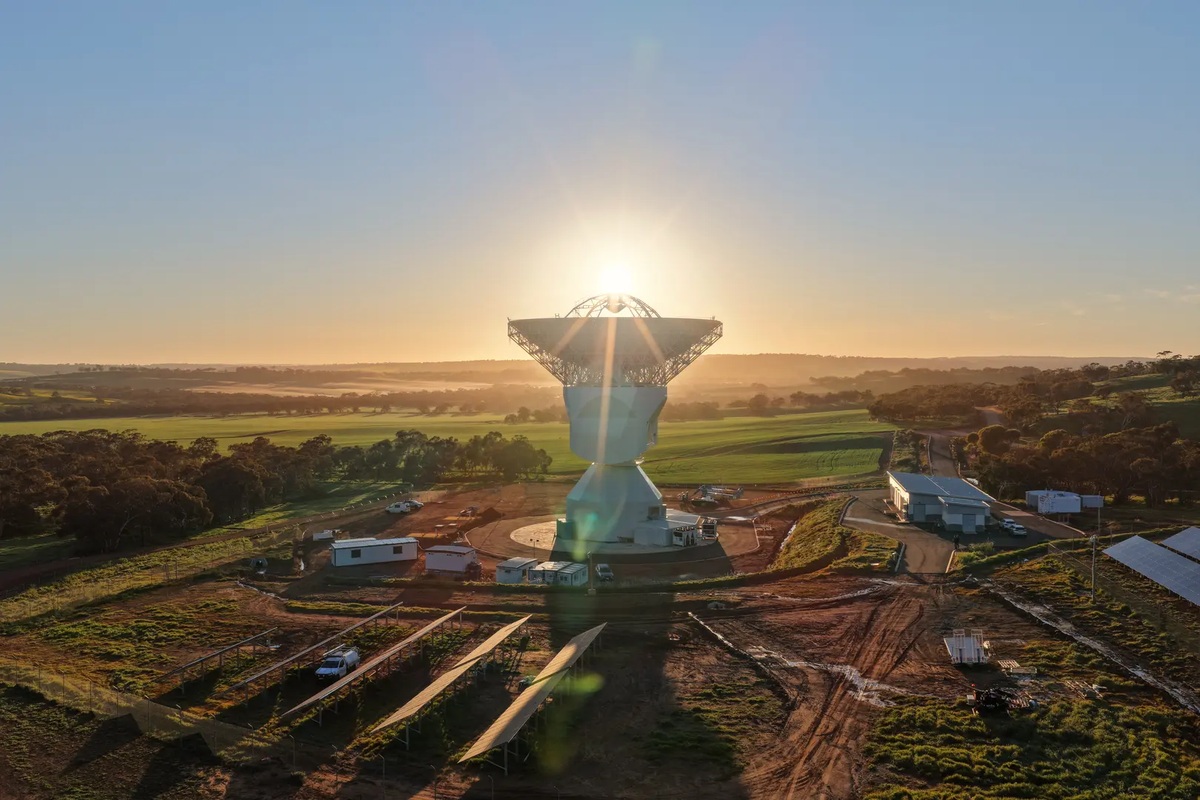
ESA can now send commands to two spacecraft at Mars through a single antenna using two different X-band frequencies, giving its busy deep-space network more room to support other missions.
The agency reported the capability on November 19 after demonstrating it with Mars Express and ExoMars Trace Gas Orbiter. Its 35-meter Deep Space Antenna 4 at New Norcia, Western Australia, now routinely supports both orbiters during the same pass.
The difficult part is sending commands
Receiving signals from several spacecraft through one dish is already established practice. Transmitting two command signals together is harder because the signals can interfere with each other.
A hybrid coupler built by Thales Alenia Space allows the antenna’s feed to handle the two X-band command signals safely. ESA engineers say they are unaware of another deep-space station offering the same capability.
The arrangement has a geographical limit: the spacecraft must appear close enough together in the sky for the same antenna pointing to reach both. Two orbiters around Mars are well suited to it; spacecraft scattered across the Solar System are not.
More capacity without another dish
Ground-station time is a finite resource. When two missions can share a pass, other spacecraft have less competition for access to the network. ESA says demand is growing as more missions seek tracking and communications support.
Its older New Norcia antenna had already commanded the Mars orbiters together by combining S-band and X-band transmissions. That approach relied on Mars Express carrying both systems and required additional preparation. Using X-band for both spacecraft removes those particular constraints.
A larger network takes shape
DSA 4 joined an Estrack network with 35-meter deep-space dishes in Australia, Spain and Argentina. The stations are operated remotely from ESA’s control center in Darmstadt, Germany.
The agency plans to include the dual X-band capability in its next deep-space antenna, DSA 5. That makes the demonstration a model for future infrastructure as well as a practical improvement for the two spacecraft already at Mars.