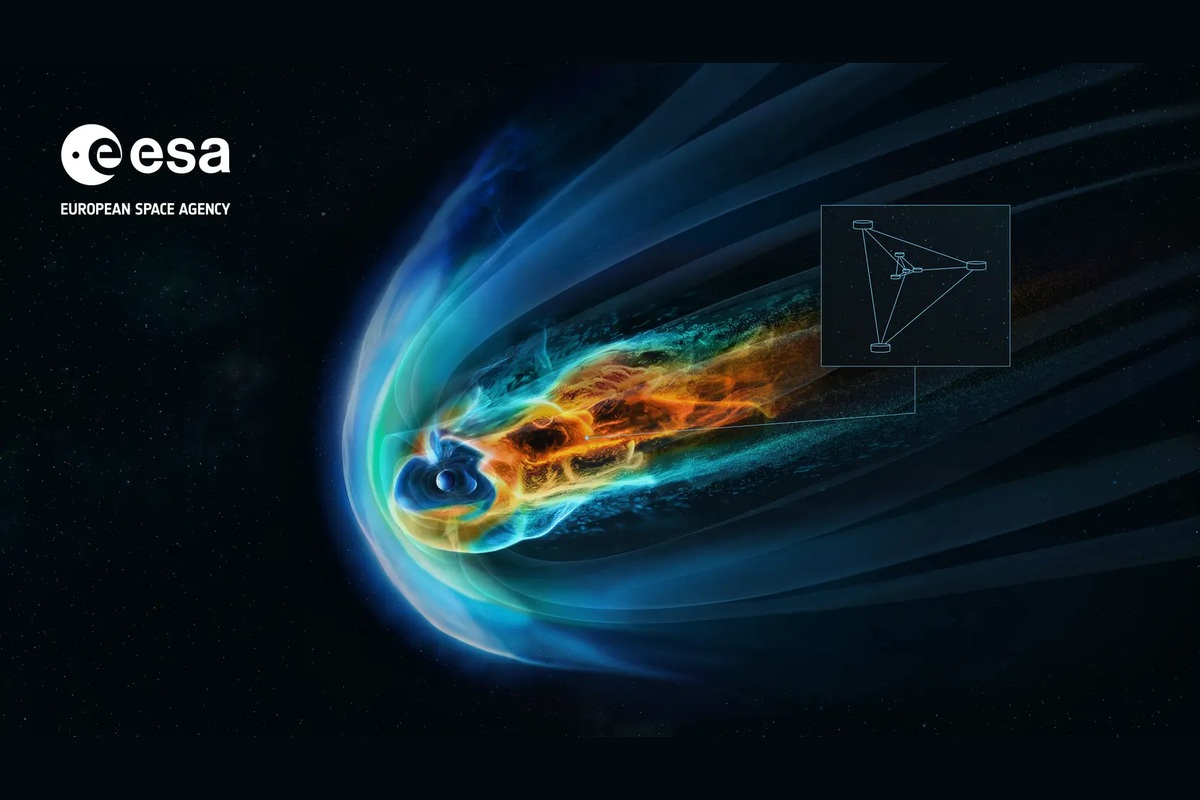
Europe has chosen a fleet of seven spacecraft to investigate how energy from the Sun moves through Earth’s magnetic shield, advancing a mission designed to connect small disturbances in space with changes across the planet’s wider environment.
ESA announced the selection of Plasma Observatory on November 19. The mission will make coordinated measurements at multiple locations, tackling a limitation of earlier observatories that could examine only one spatial scale at a time.
Following energy from small disturbances to large events
The solar wind is a continuous stream of charged particles. Earth’s magnetic field diverts much of that flow, but the interaction remains dynamic: particles gain energy, magnetic structures change and disturbances travel through the region surrounding the planet.
Plasma Observatory will measure electric and magnetic fields alongside particles at seven points simultaneously. The goal is to determine how fast, local events connect with much larger changes, rather than assembling that picture from observations taken at different times.
The mission builds on ESA’s Cluster quartet, which began studying Earth’s magnetic environment in 2000. Its successor’s larger formation is intended to capture the fine detail and the broader setting together.
A natural laboratory close to Earth
These interactions can produce auroras and, in severe cases, disrupt satellites and electricity infrastructure. The observatory’s central purpose is to understand the physics behind them. Earth offers an accessible laboratory for processes that also occur around other stars, where direct spacecraft measurements are impossible.
The selection also provides a longer-term direction for European heliophysics, the study of the Sun and its influence across space.
Selection comes before construction
Plasma Observatory fills ESA’s M7 medium-class mission slot. Formal adoption, the decision committing a mission to full implementation, still lies ahead. Launch is provisionally foreseen for the late 2030s.
ESA also shortlisted four concepts for its following medium-class mission and three for a fast-class mission. Those candidates enter further studies in 2027; they have not yet been selected to fly.