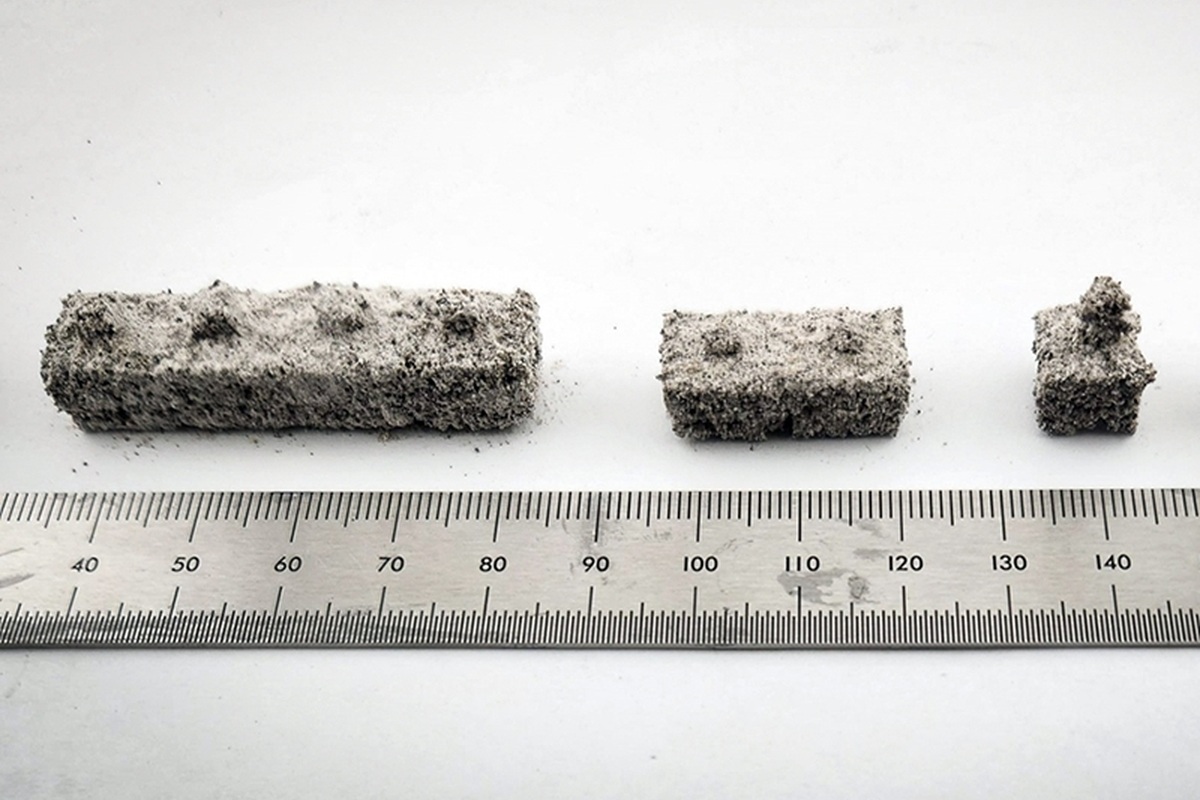
Researchers have used a laser to turn simulated Moon dust into small, interlocking construction blocks without adding a separate binding material, testing a possible way to make building supplies from resources already on the lunar surface.
The University of Arkansas highlighted the work on November 10. The study, published in August 2026 in npj Advanced Manufacturing, is a laboratory proof of concept using a commercial lunar-regolith substitute.
Printing the connections into the blocks
The researchers used laser powder bed fusion: a light source heats selected parts of a thin powder layer until the particles bond, then additional layers build up the object.
Rather than printing an entire habitat, the researchers explore modular pieces that can be rearranged into larger structures. The team produced blocks a few centimeters across, including cross-shaped and H-shaped elements that fit together.
Eliminating binders matters because those extra materials would otherwise have to come from Earth. The experiment instead relies on the regolith simulant bonding to itself.
The strength problem remains
The resulting pieces are porous and weaker than comparable objects made using binders. They can support themselves, but that does not make them ready to carry the loads of a working lunar building.
The research paper reports a peak compressive stress of about 1.5 megapascals for tested cubic samples. That is a measured laboratory result, not certification of the interlocking designs for construction.
A manufacturing method still needs a lunar test
The team used Lunar Highlands Regolith Simulant, or LHS-1, which is designed to resemble material collected during the Apollo missions. It did not print the blocks on the Moon or use actual lunar samples.
Further work must improve mechanical performance and establish how the process behaves in low gravity and vacuum. Those steps will determine whether a useful laboratory technique can become a practical part of future lunar construction.