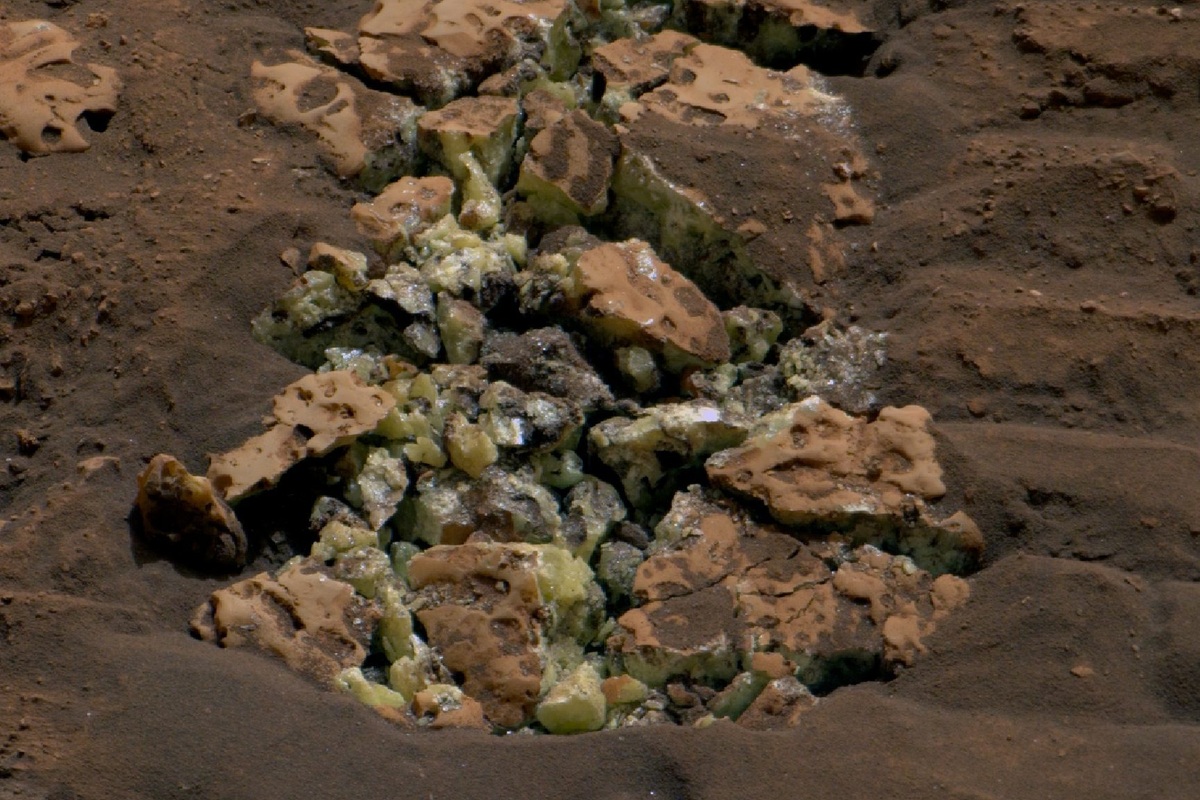
NASA’s Curiosity rover rolled over a rock on Mars and split it open, exposing yellow crystals that scientists had never identified there before: sulfur in its pure, elemental form.
The accidental discovery occurred on May 30, 2024, in Gediz Vallis channel on Mount Sharp. NASA announced the finding that July. The encounter has since prompted research into how the deposit formed and survived for billions of years.
Why the yellow crystals were a surprise
Sulfur-bearing minerals were already familiar to Mars scientists. Curiosity was traveling through terrain rich in sulfates, salts in which sulfur is chemically combined with oxygen and other elements. The newly exposed crystals were different: elemental sulfur.
Curiosity’s Alpha Particle X-ray Spectrometer, mounted on its robotic arm, helped determine the material’s composition. NASA identifies the broken fragments as “Convict Lake,” a collection about 5 inches, or 13 centimeters, across. The rover photographed the crystals on June 7, 2024.
Project scientist Ashwin Vasavada described the field of sulfur stones as “like finding an oasis in the desert.” The comparison captured the geological surprise: scientists had not expected the conditions needed to create such a deposit at that location.
Later research points underground
Researchers subsequently proposed that magma beneath the surface released sulfur-bearing gases that reacted to produce the deposit roughly 3 billion years ago. Washington University in St. Louis outlined that interpretation in August 2026, describing work co-led by Scott VanBommel and Jeff Berger.
The stones’ fragile, exceptionally pure condition suggests they formed close to where Curiosity found them. Transport over a substantial distance would likely have broken them apart or mixed them with other material.
A clue to Mars’s environment
The researchers also argue that the sulfur’s preservation points to little prolonged contact with liquid water after formation. Its lack of oxidation adds another constraint on the conditions that followed.
The team found no evidence that ancient microbes produced the stones. Their importance is geological: a chance encounter exposed a deposit that helps scientists reconstruct a part of Mars’s environmental history that had remained hidden beneath an ordinary-looking surface.