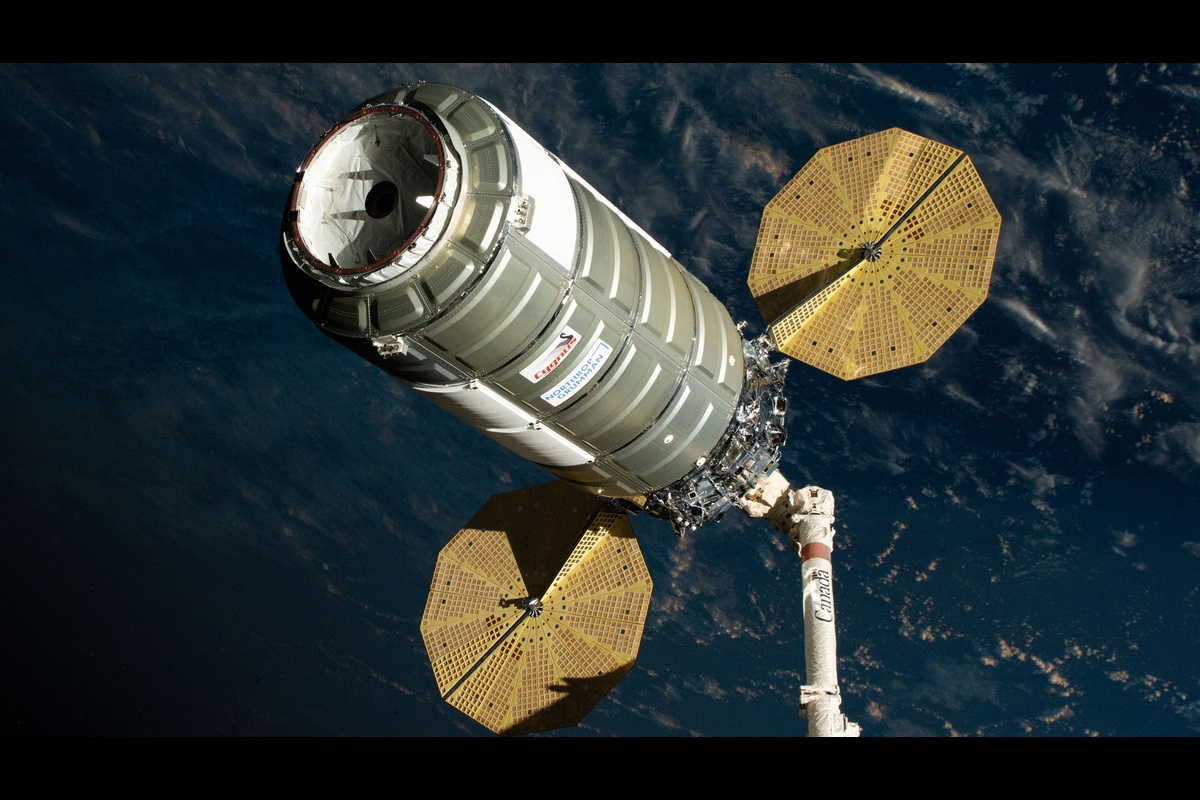
NASA has cleared continued preparations for a November 29 cargo launch to the International Space Station, carrying a prototype crop-growing system and hardware for long-duration studies of human brain tissue in space.
The agency said on November 27 that station managers had voted to proceed with Northrop Grumman’s CRS-25 mission. The Cygnus XL spacecraft is due to carry approximately 11,000 pounds of science, supplies and equipment aboard a SpaceX Falcon 9.
A Sunday launch, with weather still a concern
Liftoff is scheduled for 10:47 a.m. EST on Sunday, November 29, or 15:47 UTC, from Space Launch Complex 40 at Cape Canaveral Space Force Station in Florida.
NASA’s November 27 forecast put the chance of favorable conditions at 60%, with thick clouds the principal concern. If Sunday’s attempt cannot proceed, the next available opportunity is 10:24 a.m. EST on Monday, November 30. Those remain planned launch opportunities rather than a guarantee that the spacecraft will fly.
Testing how to grow food farther from Earth
The Ohalo III growth chamber is designed to investigate crop production in microgravity. NASA outlined the experiment on November 27, highlighting tests of water delivery and efficient use of the chamber’s growing space.
The prototype could inform food-production systems for future Moon habitats and Mars missions. It is an experiment to validate the equipment and its performance, rather than a replacement for the station’s regular food deliveries.
SpaceWitness reported this week on astronauts adding station-grown plants to their Thanksgiving menu. Ohalo III addresses the longer-term engineering challenge behind such harvests: making crop production reliable enough to support more distant crews.
Keeping tiny brain models alive
A second investigation will test a miniature fluid-handling system for maintaining lab-grown human brain-tissue models. The equipment mixes and delivers the nutrient-rich liquid that keeps those tissues alive.
It builds on previous research involving small brain models called miBrains. Researchers want to support longer studies of neurological risks during spaceflight, with potential applications to disease modeling on Earth. The fluid system is a step toward sustaining those models for longer experiments.
A larger Cygnus and a broader science load
NASA describes this as the third flight of Cygnus XL, the enlarged version of Northrop Grumman’s cargo spacecraft. The vehicle is named for astronaut Jim Lovell, who flew on Gemini missions and Apollo 8 and 13.
After rendezvous, Jessica Watkins is assigned to capture Cygnus with the station’s Canadarm2 robotic arm while Luke Delaney monitors its arrival. Ground controllers will then install the spacecraft on the Earth-facing port of the Unity module.
Other investigations on the manifest study muscle loss, targeted drug delivery, cancer-cell behavior and radiation monitoring. Alongside crew supplies, they give the delivery a role beyond keeping the station stocked: testing tools that could support astronaut health and future exploration.