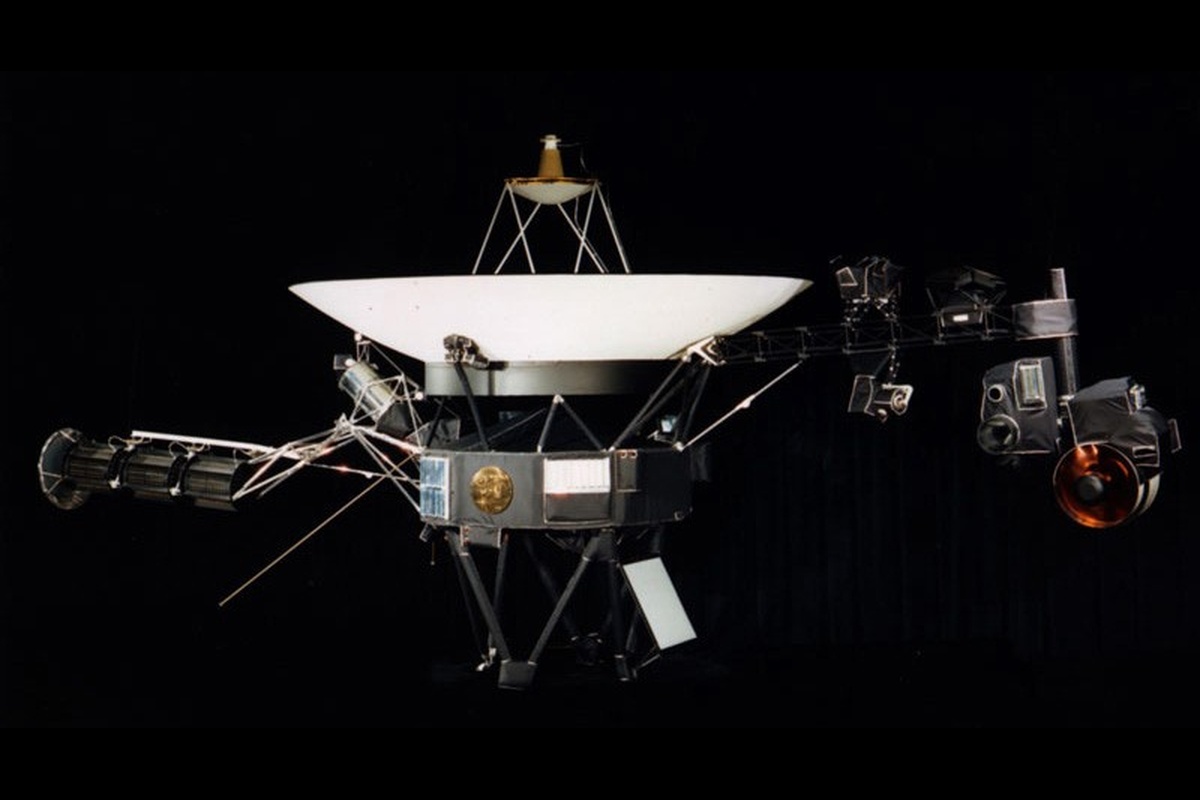
Voyager 1 has stopped sending science and engineering data back to Earth, leaving NASA to troubleshoot humanity’s most distant spacecraft across a radio journey that now takes roughly two days for a command and reply.
The probe’s signal is still arriving. NASA disclosed the data interruption on November 18, saying engineers first detected it on November 14. The fault predates Voyager 1’s historic arrival at one light-day from Earth, and its cause remains under investigation in the agency’s published updates.
A signal without the measurements
A Deep Space Network antenna in Canberra, Australia, detected Voyager 1’s radio carrier but received none of the science readings or engineering information normally transmitted with it.
That carrier is an important clue: NASA says its presence indicates that the spacecraft’s antenna and broadcasting equipment work, and that its attitude-control computer is keeping it pointed toward Earth.
The missing data suggest a problem with the onboard computer that gathers information from the spacecraft’s systems and prepares it for transmission. That is a working diagnosis, rather than a confirmed explanation.
Why every exchange takes two days
Voyager 1 reached one light-day from Earth on November 18, at a distance of about 16.1 billion miles, or 25.9 billion kilometers. NASA confirmed the milestone the following day using its carrier signal and trajectory calculations.
Radio waves travel at the speed of light. A command therefore needs about 24 hours to reach the probe, and its reply needs another 24 hours to arrive back at Earth. That is the travel time alone: preparing a test, scheduling communications and interpreting the result can extend the wait.
Crossing that distance did not trigger a physical change aboard Voyager. The data interruption had already begun four days earlier. As SpaceWitness explained ahead of the milestone, a light-day measures distance, not a new boundary in space.
A previous repair offers experience
The team has dealt with a similar loss of data before. In November 2023, Voyager 1 stopped returning readable science and engineering information after a fault in its flight data subsystem.
JPL reported in April 2024 that engineers had traced that failure to a memory chip. They divided affected software into sections and relocated it within the computer’s remaining memory, restoring engineering updates after five months.
That recovery gives the team useful experience, but it does not establish that the new interruption has the same cause or can be fixed the same way.
Keeping a 49-year-old spacecraft working
Voyager 1 also briefly lost its radio signal in October. JPL reported that ground antennas could not detect it during scheduled contacts on October 18 and 19; the signal returned on October 20. Engineers found that a group of thrusters had gone offline and backups had activated automatically.
The spacecraft’s aging power supply presents another constraint. Its generator converts heat from decaying plutonium into electricity, and available power declines by about four watts annually. Engineers completed a coordinated switch to lower-power equipment in September to extend science operations.
Voyager 1 launched in 1977 and entered interstellar space in 2012. Restoring its data would allow scientists to resume receiving direct measurements from a region reached by only the two Voyager probes. For now, its radio carrier preserves a vital connection while engineers work to recover the information it should carry.