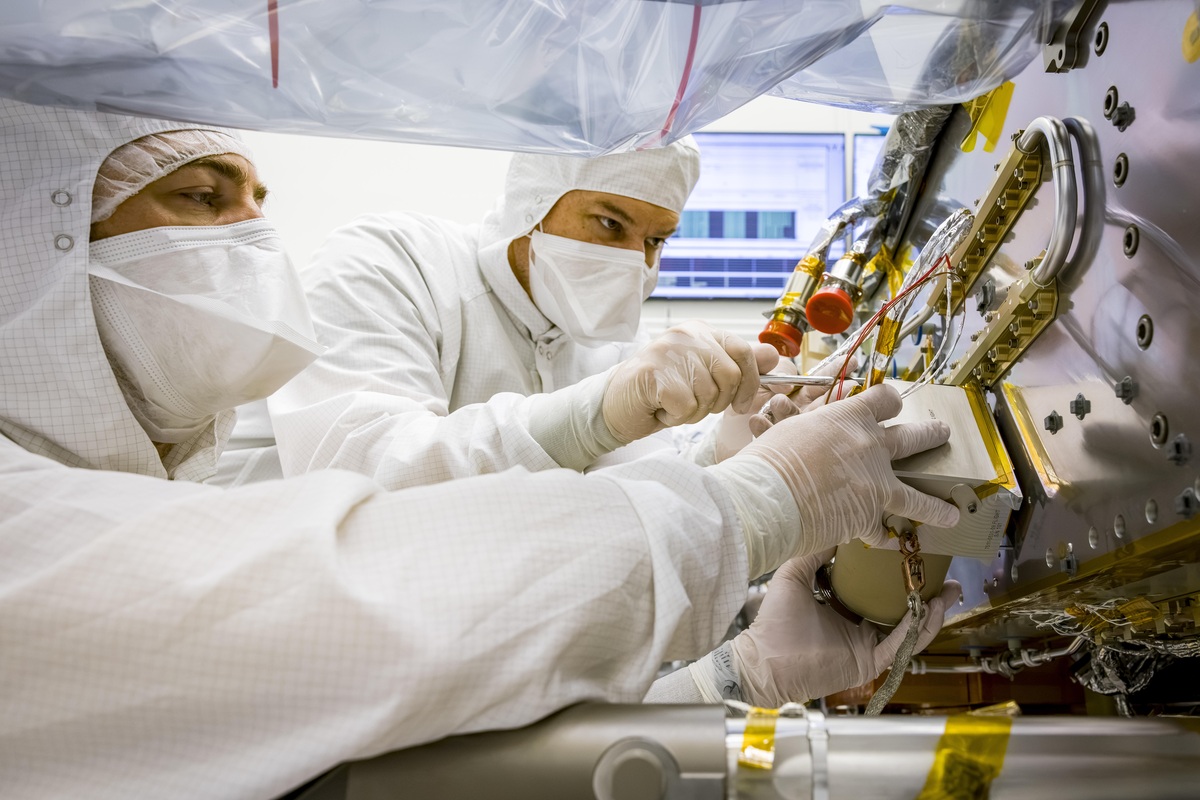
NASA’s Dragonfly rotorcraft has received its seven science cameras, adding the instruments that will let researchers connect Titan’s landscapes with the samples the mission collects.
NASA reported the milestone on November 24. The DragonCam suite, built by Malin Space Science Systems, was installed, tested and integrated at Johns Hopkins Applied Physics Laboratory in Maryland by mid-November.
From panoramas to individual grains
DragonCam combines forward- and side-facing views with downward-looking cameras and a microscopic imager. Together, they will document the terrain and give scientists a close view of material around the spacecraft’s sampling sites.
The suite is separate from Dragonfly’s two navigation cameras, which were installed earlier this year. Science images will help researchers interpret what the sampling instruments collect.
A flying laboratory for Saturn’s largest moon
NASA plans to fly Dragonfly between multiple locations on Titan during a surface mission lasting about 3.3 years. Dunes and the region around Selk Crater are among the environments the team intends to investigate.
At successive stops, the rotorcraft will collect surface material for onboard analysis. Observing different geological settings should help the team assess Titan’s habitability and investigate the complex chemistry that can precede biology.
The camera views provide the link between a sample and its surroundings. A measurement from a drill site becomes more useful when researchers can also see the grains, surface features and broader landscape associated with it.
Integration continues before a long journey
Dragonfly targets launch no earlier than July 2028 and arrival at Titan in late 2034. The mission is being designed and built under APL’s direction as part of NASA’s New Frontiers program.
The camera installation is one step in assembling the scientific payload. Other instrument packages are due for delivery, integration and testing over the coming months, as the spacecraft takes shape for a mission far beyond Earth.