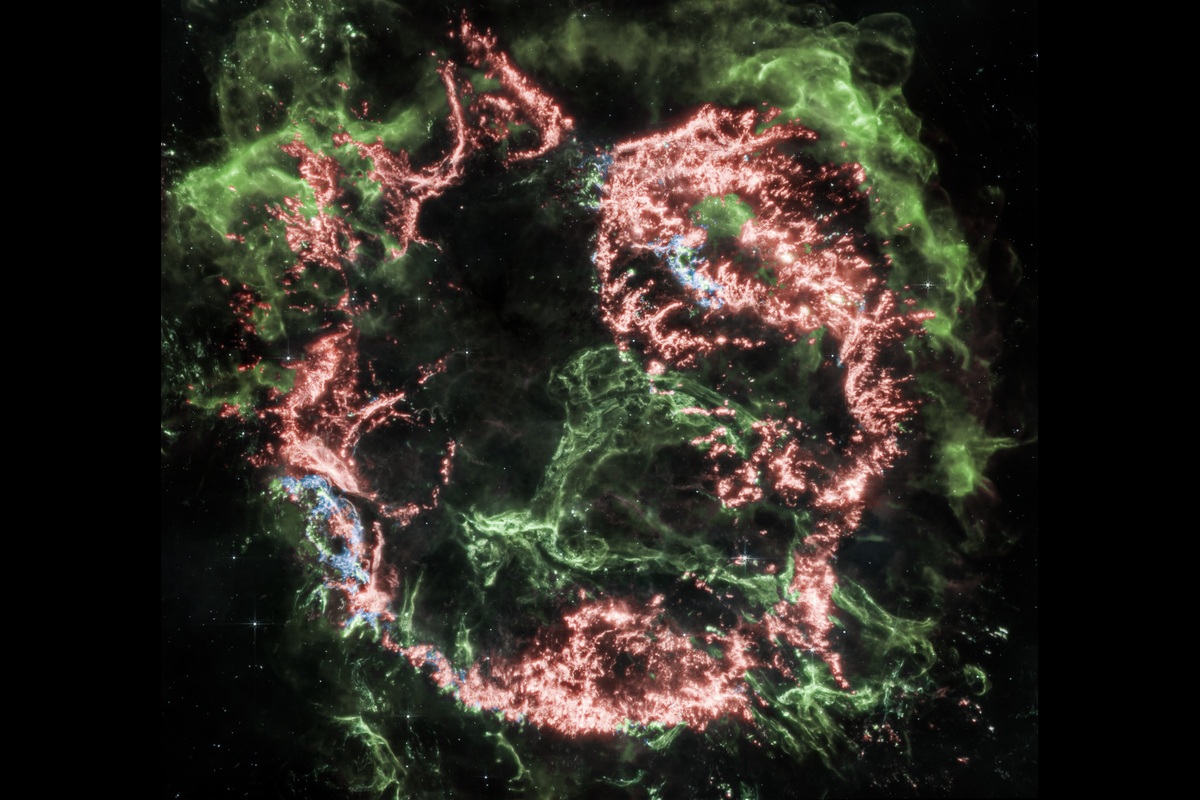
A star’s scattered remains are helping astronomers reconstruct what happened inside it shortly before it exploded. New James Webb Space Telescope observations of Cassiopeia A support the idea that internal layers mixed together during the star’s final stages.
NASA reported the findings on November 23, alongside a detailed mid-infrared view of the supernova remnant. The research appears in The Astrophysical Journal Letters.
A chemical record left in dust
Massive stars develop layers in which different elements undergo nuclear fusion. Mixing between those layers can alter the material eventually expelled into space.
ESA describes how the team used Webb to examine individual dust clumps on scales comparable to the Solar System. Mapping their composition revealed evidence of a shell merger, in which previously separate layers mixed before the supernova.
The team, led by Columbia University researcher Tea Temim, interprets the chemistry as a record of changes within the original star. Those changes may have taken place only hours before core collapse.
Three regions with different ingredients
Observations from the retired Spitzer Space Telescope helped identify three regions for closer study. Two lie in an area where a reverse shock is encountering debris thrown outward by the explosion.
Webb found predominantly silica dust in one of those targets and carbon dust in the other. A third region, known as the Green Monster, contains complex magnesium silicates and originated in material shed before the star exploded.
Reconstructing an explosion after the fact
The infrared work builds on X-ray observations from Chandra and the Japan-led XRISM mission. Together, the measurements support the shell-merger interpretation, with signatures extending across much of the remnant.
The proposed timing is an inference from the debris, rather than a direct recording of the star’s final hours. The approach offers astronomers a way to investigate the interiors of stars that no longer exist, and to understand the mixture of elements their explosions release for future stars and planets.