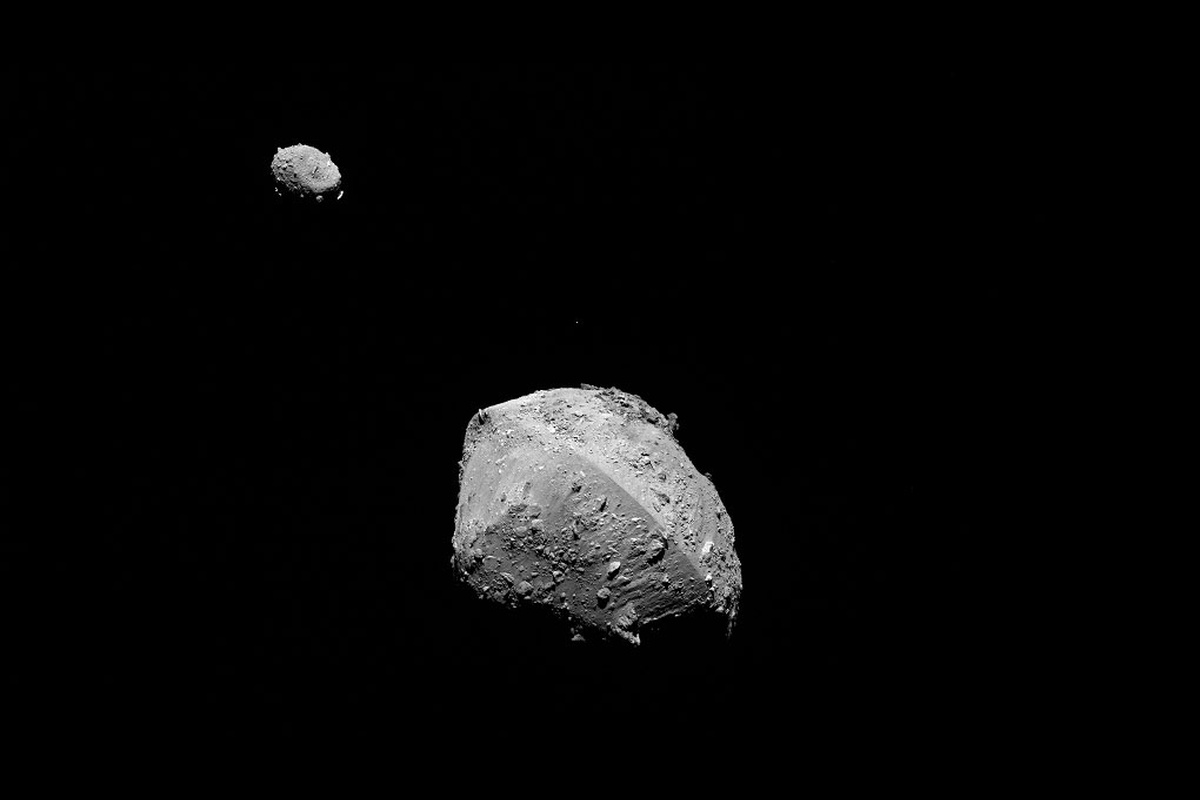
NASA’s first asteroid-deflection test left a crater across the face of Dimorphos and sent the small body tumbling. Europe’s Hera spacecraft has now photographed the damage – and found hundreds of boulders circling the asteroid pair.
The European Space Agency unveiled the findings from its Hera spacecraft on November 25. The close-up observations provide the first detailed view of the damage caused when NASA deliberately crashed DART into the small asteroid in 2022.
A crater across an asteroid’s face
Dimorphos is about 150 meters across and orbits the larger Didymos. One face of the smaller body has been flattened by a crater that ESA compares to a sports stadium. Other regions still resemble the boulder-covered terrain seen before the collision.
The German Aerospace Center, DLR, described a November 7 image taken from 29 kilometers away, with a resolution of about 2.7 meters per pixel. It reveals structures inside the impact depression, including an elongated feature near its center.
The new pictures follow the opening observations SpaceWitness reported earlier this month, when Dimorphos was largely hidden in shadow. Scientists can now examine the impact site directly.
Why the damage matters for Earth
DART struck Dimorphos on September 26, 2022, testing whether a high-speed spacecraft impact could change an asteroid’s motion. Measurements showed that the moonlet completed its orbit around Didymos about 33 minutes faster afterward. That change concerns the small asteroid’s journey around its companion.
NASA reported in 2024 that models also indicated a change in Dimorphos’ overall shape. Those earlier findings drew on spacecraft images, radar and telescope observations; Hera now supplies a close-up inspection of the aftermath.
For planetary defense, the task is to understand why this impact worked so well. The response of a loosely assembled asteroid can differ from that of a more solid body. Measuring the crater and surrounding material helps scientists test the models they would use to plan a future deflection.
A more complicated scene to navigate
Hera also sees Dimorphos tumbling and hundreds of previously unknown, meter-scale boulders around the pair. The team must account for those objects as the spacecraft moves closer.
ESA’s next planned steps include approaching to about 13 kilometers in December and releasing two small companion spacecraft in January 2027. Juventas will probe the interior with radar, while Milani will investigate surface materials and dust.
DLR says the camera images will support a three-dimensional terrain model, allowing researchers to measure the crater and assess how extensively the asteroid changed. Neither Didymos nor Dimorphos threatens Earth: this is a controlled test site for learning how to respond if a dangerous asteroid is discovered.