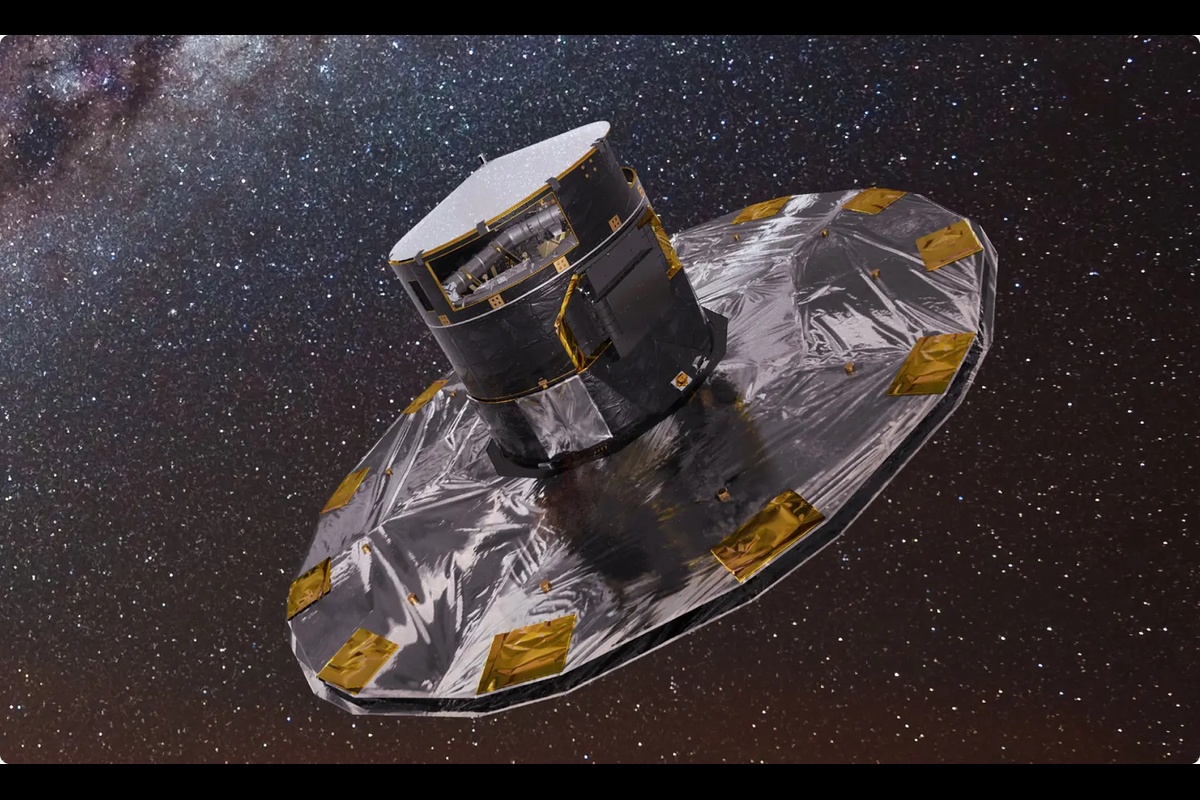
Europe’s Gaia mission is preparing to open its largest collection of cosmic measurements yet: a data release spanning 66 months of observations and offering a deeper view of roughly two billion stars and other objects.
The European Space Agency announced on November 26 that it will unveil Gaia Data Release 4 on December 2. The release is expected to give astronomers far more than a new sky map, adding measurements that show how individual objects change over time.
A vast archive, with a longer view of the sky
ESA describes a dataset containing 1.5 trillion observations of around two billion stars and other celestial objects. It draws on five and a half years of measurements, roughly half of Gaia’s observing lifetime.
The Lohrmann Observatory at TU Dresden says the archive will expand to approximately 400 terabytes, about 40 times the size of the previous version. The observations cover nearly twice the time span used for Gaia DR3.
The increase matters because a longer record gives researchers more opportunities to distinguish persistent motion from short-term variation. Repeated measurements can reveal behavior that a single position or an average brightness cannot capture.
From a star catalog to a history of change
The Paris Observatory’s Gaia team describes a major expansion in access to time-series data: measurements of position, brightness and spectra recorded across repeated visits to the same objects.
The release will include about 85 million radial velocities, which describe motion toward or away from the observer. The team also lists 2.6 million measurements of spectral-line broadening, useful for studying stellar atmospheres and rotation.
Its processing uses models better suited to individual sources, including binary-star models where appropriate, rather than treating every system as a single star. The work behind the catalog began in 2020 and has involved more than six years of processing and analysis.
Gaia stopped observing. Its scientific work continues.
Gaia surveyed the sky from July 2014 until January 15, 2025. ESA records more than three trillion observations over the full mission, measuring stellar positions, motions, brightness, temperature and composition.
DR4 therefore does not exhaust the archive. A later release covering the complete mission is planned no earlier than the end of 2030. The spacecraft’s observing work has finished, while the task of turning its measurements into usable scientific results continues.
When the data and presentation arrive
TU Dresden lists the archive opening for noon CET on December 2, or 11:00 UTC. ESA’s public presentation follows from 14:45 to 16:30 CET, or 13:45 to 15:30 UTC, on ESA Web TV and its YouTube channel.
The catalog has not been released yet. December 2 is the planned opportunity for researchers to begin exploring the new products and testing what the longer record reveals about the Milky Way.